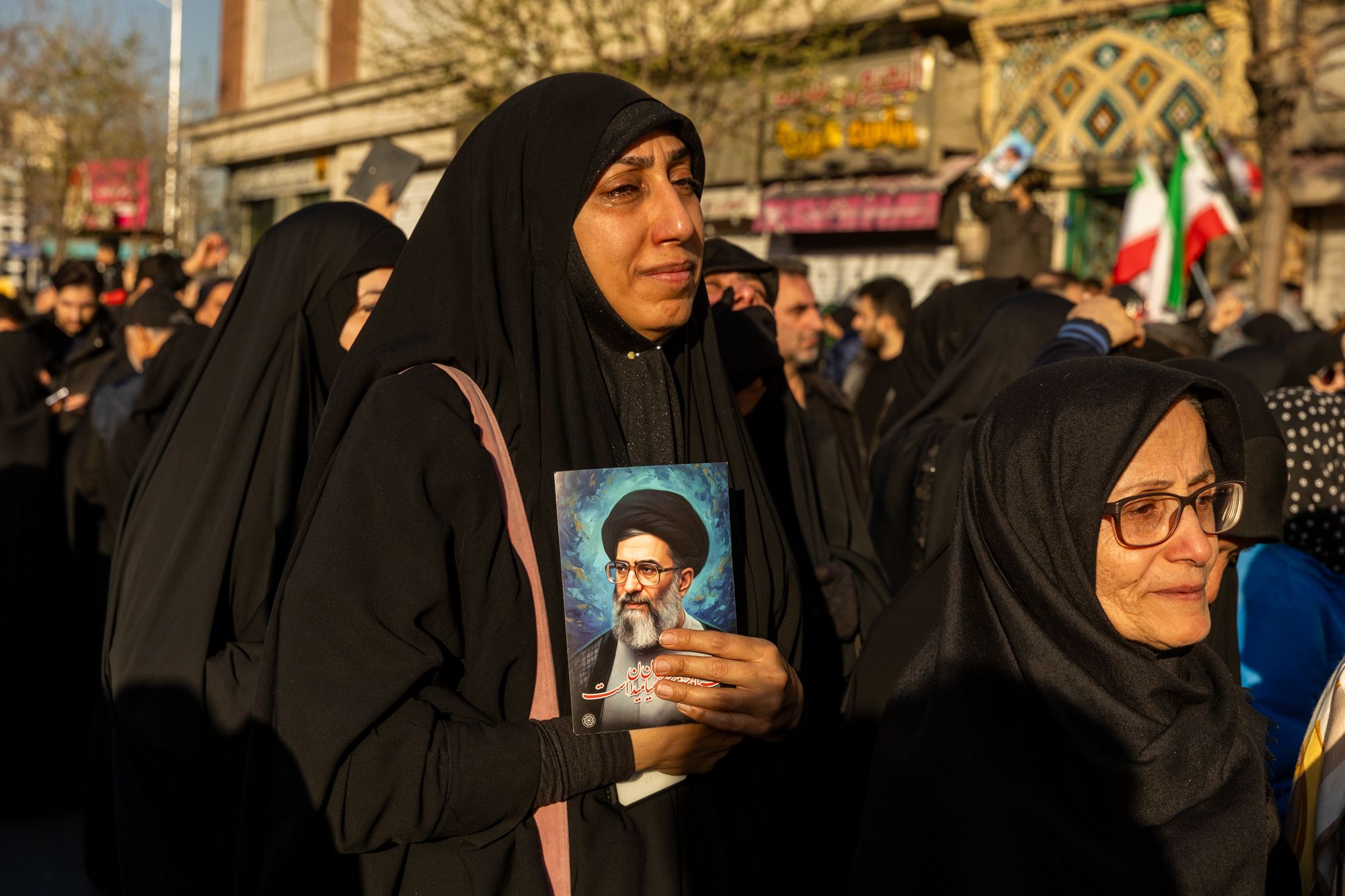
For the first time in decades, Iranians woke to a country without Ayatollah Ali Khamenei as supreme leader, following his death in coordinated US-Israeli strikes. The nation now confronts a period of deep uncertainty.
Diverse reactions unfolding nationwide
The news of Khamenei’s death has provoked a wide spectrum of reactions across Iran. In the capital and other cities, some citizens expressed cautious relief, viewing the end of his decades-long rule as a potential turning point. Celebrations erupted in certain neighborhoods, with people honking horns, waving clothes, and even toppling monuments associated with the Islamic Republic’s founders. Videos circulating online from cities such as Isfahan, Abdanan, and Galleh Dar capture spontaneous street gatherings and public displays of jubilation.
For many, however, the atmosphere proves far more nuanced, as worries about the country’s near-term trajectory, the risk of intensifying conflict, and the prospect of deeper turbulence dim any sense of celebration. People in Tehran described streets that remained mostly subdued, with only small clusters stepping outside, a scene shaped by both prudence and unease. “I’m glad he’s gone, but it still doesn’t quite feel real,” a local resident noted, capturing a blend of relief and lingering anxiety.
Growing escalation and mounting regional strains
The circumstances surrounding Khamenei’s death have heightened tensions across the region, with Israeli strikes hitting locations throughout Iran, including an assault near a military base in Minab that Iranian state media claims resulted in the deaths of more than 150 schoolgirls. In response, Iran carried out attacks on US and Israeli military sites in multiple countries, causing casualties among all parties involved. Reports note that three US soldiers lost their lives, at least nine fatalities occurred in Israel, and many others were injured.
Residents in Iran portray the capital as strained, with some neighborhoods looking empty and little movement in public spaces. Although occasional celebrations still occur, the continuing military operations and the possibility of new attacks have fostered a sense of unease. Analysts caution that the mix of internal turmoil and escalating regional conflict could push the country toward greater instability.
Political uncertainty and succession
Khamenei’s death raises a pivotal issue regarding who will assume leadership in the Islamic Republic. Because no successor was ever formally named, the nation now enters a complicated period of transition at the top tier of its government. Iran’s Revolutionary Guard and other major state bodies are anticipated to exert significant influence over this process, while interim arrangements have reportedly begun under President Masoud Pezeshkian’s supervision. Iranian Foreign Minister Abbas Araghchi indicated that the selection of a new supreme leader might occur within a matter of days.
Beyond selecting a successor, the larger issue lies in whether the current power apparatus can preserve stability. Israel reports that many of Iran’s highest-ranking military figures were eliminated in the initial strikes, including 40 senior commanders, according to the Israel Defense Forces. This leadership vacuum intensifies worries about possible internal rivalries and the threat of widespread disorder.
Analysts note that many Iranians view Khamenei’s death as insufficient for systemic change, seeing it instead as an externally imposed shift rather than a domestic transformation. Opposition figures and segments of the population continue to call for democracy and fundamental reforms, but organizing such movements remains difficult given government restrictions and internal divisions.
Local and global viewpoints
Public opinion within Iran is deeply divided. While some welcome the removal of a long-standing authoritarian figure, others fear that the country could descend into further repression or even face another dictatorship. The death of Khamenei through foreign military intervention complicates sentiments, leaving some citizens conflicted about celebrating a change brought by external forces rather than an internal movement.
Outside Iran, members of the Iranian diaspora expressed relief and even joy at Khamenei’s death. Demonstrations in cities such as London and Los Angeles saw groups of expatriates celebrating what they viewed as the end of an oppressive era. However, these international celebrations contrast sharply with the precarious situation inside the country, where the balance between hope for reform and fear of instability is delicate.
The path forward
The upcoming days and weeks are expected to be decisive for Iran, with central priorities involving the consolidation of its leadership, the reinforcement of national security, and the formulation of the government’s strategy toward persistent military threats. Citizens and analysts are watching events unfold with great attention, especially regarding any possible escalation with Israel and the United States.
For many Iranians, Khamenei’s death represents both an end and a beginning. It closes a chapter defined by decades of political control, religious authority, and economic challenges, while opening an uncertain future that may offer opportunities for reform but also carries the risk of renewed conflict.
Observers emphasize that meaningful change will likely require more than the removal of a single figurehead. Structural reform, effective opposition organization, and regional diplomacy will all be necessary to navigate the complexities of post-Khamenei Iran. The interplay between internal desires for transformation and external pressures from foreign powers will shape the trajectory of the country in the months ahead.
As Iran enters this volatile period, residents are seeking stability, clarity, and a vision for the nation’s future. While celebrations and mourning coexist, the overriding sentiment is a cautious watchfulness, as the country contemplates both the promise and the peril of this historic moment.