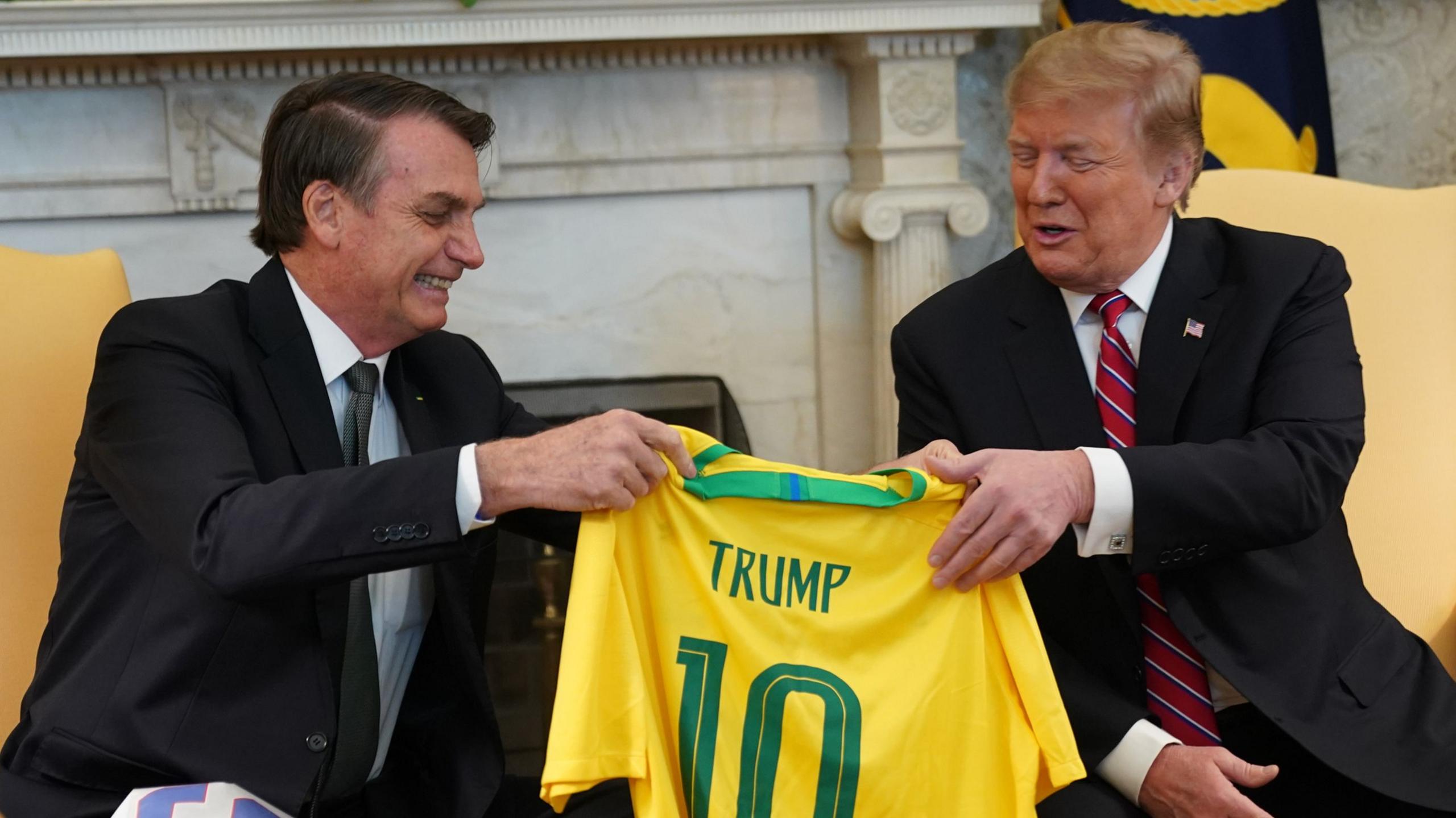
Former U.S. President Donald Trump has come forward to defend Brazil’s ex-leader Jair Bolsonaro, denouncing the legal proceedings against him as a politically motivated “witch hunt.” Trump’s remarks, shared via social media and subsequent public appearances, have sparked international debate about the intersection of politics, justice, and democracy in both Brazil and the United States.
The remarks were made while Bolsonaro, the ex-right-wing leader of Brazil, is confronting increasing legal challenges in his homeland. Probes into his involvement in the January 8, 2023, incidents at Brazil’s Congress, Supreme Court, and presidential palace—widely regarded as an attempted insurgency—have resulted in more legal investigations. Brazilian officials are investigating whether Bolsonaro, who was not in the country during the incidents, contributed to the provocation or lacked actions to stop the violent rebellion initiated by his followers after he lost the election.
Trump, known for his close political alignment with Bolsonaro, dismissed the legal scrutiny as an unjustified persecution of a political figure who, in his view, championed traditional values and resisted the rise of left-leaning politics in Latin America. Drawing parallels to his own legal battles in the United States, Trump framed the situation as part of a global pattern where conservative leaders are, he claims, unfairly targeted by politically motivated investigations.
In his remarks, Trump stated that Bolsonaro, like himself, represents the will of the people and has become a victim of what he described as “radical left” political forces determined to silence opposition. He argued that the legal challenges facing Bolsonaro are not only unwarranted but are also damaging to Brazil’s democratic institutions by eroding trust in the fairness of judicial proceedings.
Trump’s remarks swiftly grabbed attention both in Brazil and around the world, introducing extra complications to an already intricate legal and political turmoil in South America’s biggest democracy. Bolsonaro’s backers have appreciated Trump’s involvement, considering it as confirmation of their view that the past Brazilian president is being unjustly criticized for political motives. On the other hand, detractors have claimed that Trump is meddling in another country’s domestic matters and compromising judicial autonomy.
The similarities between Trump and Bolsonaro have been frequently observed by political commentators. Both leaders have fostered populist personas, stressed nationalist language, and portrayed themselves as outsiders challenging what they label corrupt political elite. Each also confronted widespread demonstrations, disputed election results, and were accused of urging or not denouncing violent acts by their followers intended to disrupt democratic systems.
In Brazil, the investigations into Bolsonaro have intensified over the past year. Authorities are looking into several allegations, including his potential role in spreading false claims about election fraud, his alleged encouragement of anti-democratic protests, and his broader conduct while in office. The January 8 attack on Brazil’s key government institutions is considered by many to be the culmination of months of inflammatory rhetoric that sought to delegitimize the electoral process after his narrow loss to President Luiz Inácio Lula da Silva.
Brazil’s Supreme Electoral Court has already issued rulings that prevent Bolsonaro from running for office until at least 2030, citing abuse of political power and misuse of state media channels to spread misinformation. The separate criminal investigations could lead to even more severe consequences, including imprisonment, if Bolsonaro is found guilty of involvement in acts that sought to subvert Brazil’s democratic order.
Trump’s choice to openly support Bolsonaro highlights not just their individual political partnership but also a wider ideological connection among international right-wing groups. Both figures have promoted stories of being targeted, claiming that institutional powers—be they judicial, political, or media—work to silence opposing conservative opinions. This discourse has played a crucial role in keeping the dedication of their political supporters, despite facing significant legal challenges.
The response in Brazil to Trump’s support for Bolsonaro has been notably split. Bolsonaro’s followers have welcomed the likening to Trump, seeing each as icons of defiance against what they consider to be increasing authoritarianism by governments with leftist tendencies. They contend that the legal proceedings against Bolsonaro are driven not by justice but by an aim to eliminate political dissent and strengthen their hold on power.
Opponents of Bolsonaro, on the other hand, perceive the analogy with Trump as additional confirmation of the threat posed by populist leaders who weaken democratic structures, challenge the validity of elections, and encourage extremist conduct among their supporters. A significant number of Brazilians consider the investigations to be a needed and legitimate reaction to an unparalleled attack on their nation’s democratic system.
Legal experts in Brazil have stressed that the investigations are grounded in existing legal frameworks designed to protect democratic governance and prevent the recurrence of political violence. They argue that holding public officials accountable for their actions—especially in the wake of anti-democratic events—is essential for maintaining the rule of law.
The international dimension of the situation is also noteworthy. Brazil’s handling of the Bolsonaro investigations is being closely watched by other nations, particularly as concerns grow over the global rise of populist movements and political polarization. How Brazil’s judicial system manages the delicate balance between accountability and political neutrality could set important precedents for other democracies facing similar challenges.
In the United States, Trump’s commentary on Brazil reflects his continued efforts to cast himself as a global defender of nationalist populism. It also underscores his ongoing attempts to frame his own legal troubles—including multiple indictments related to his alleged efforts to overturn the 2020 U.S. presidential election—as politically motivated. By aligning himself with Bolsonaro, Trump reinforces his narrative of persecution while appealing to international right-wing audiences.
Both Trump and Bolsonaro have cultivated strong online followings, utilizing social media to bypass traditional media channels and communicate directly with supporters. This strategy has been key to maintaining their political relevance even when out of office or under legal scrutiny. The digital mobilization of their respective supporters has, in some cases, contributed to social unrest and heightened political tensions.
The broader implications of this transnational alignment of populist leaders are significant. Political analysts warn that the normalization of claims of election fraud, the questioning of judicial legitimacy, and the incitement of political violence could erode democratic norms not just in individual countries but globally. When powerful political figures dismiss legal accountability as mere persecution, it can undermine public trust in democratic institutions.
As the investigations into Bolsonaro continue, Brazil faces a critical juncture. The decisions made by prosecutors, judges, and political leaders will not only shape the country’s immediate political future but also influence global perceptions of how democracies respond to internal threats. Whether Bolsonaro faces criminal penalties or political rehabilitation remains to be seen, but the legal process is likely to be lengthy and politically charged.
For Trump, speaking out on behalf of Bolsonaro is consistent with his broader strategy of appealing to grievances among conservative voters, portraying legal accountability as a political weapon, and positioning himself as an international symbol of resistance to liberal governance. Whether this alignment will yield tangible political benefits remains unclear, but it underscores the enduring influence of populist narratives in the current global political landscape.
As Brazil’s institutions grapple with the legal and political aftermath of the January 8 attacks, the challenge will be to uphold the principles of democracy, ensure accountability for any wrongdoing, and resist the polarizing forces that have tested democratic resilience in both Brazil and other nations around the world.
The coming months will be critical in determining not only Bolsonaro’s fate but also the strength of democratic governance in a region that has historically struggled with political instability. Meanwhile, Trump’s intervention serves as a reminder that in today’s interconnected world, the battles over democracy, justice, and power often transcend national borders.